




How often has your team meticulously designed the perfect product or created visually stunning content, only to be met with a deafening silence from the market? Trying to sell to everyone is one of the fastest ways to drain a company’s resources.
When you attempt to be a solution for all, your brand risks becoming invisible, meaningless to anyone. This is where the segmentation, targeting, and positioning (STP) framework steps in as a strategic foundation, ensuring your message reaches the right people, at the right time, and in the right way.
Understanding Segmentation, Targeting, Positioning (STP)
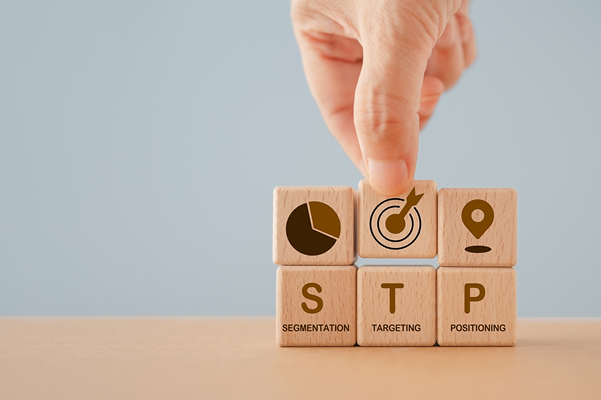
Simply put, what is segmentation targeting and positioning? It is a sequential process of dividing the market into specific groups (segmentation), selecting the most potential segments (targeting), and then determining how you want your product to be perceived (positioning).
These three elements are intrinsically interconnected. Without segmentation, targeting becomes mere guesswork. Without positioning, your brand will easily drown in an increasingly crowded marketplace. Understanding the basic concepts of STP strategy is crucial because it transforms scattered efforts into a focused laser beam of marketing efficiency.
Segmentation
Segmentation is the process of breaking down a broad market into smaller, more manageable groups based on specific characteristics. This allows businesses to understand patterns in needs and behaviors within each group. Common segmentation approaches include:
1. Demographic Segmentation
This is the most widely used method because demographic data is readily available. Variables include age, gender, income, education, and occupation.
For instance, an anti-aging skincare line naturally appeals more to adults over 30 than to teenagers. Similarly, a premium investment product targets middle- to high-income earners.
2. Geographic Segmentation
Markets can also be divided based on location, such as country, city, region, or even climate. An example of implementation can be seen in winter jacket products, which are more suitable if marketed in cold climate regions. Meanwhile, culinary brands also need to perform this segmentation to adjust flavors to local preferences in every city.
3. Psychographic Segmentation
This segmentation goes much deeper because it touches on lifestyle, interests, values, and consumer personality. But when is this segmentation needed?
As an illustration, two people with the same age and income do not necessarily have the same lifestyle. One might be fond of outdoor activities, while the other prefers indoor activities. Because of these different lifestyles, the way you market your product must also differ.
4. Behavioral Segmentation
This segmentation focuses more on consumer habits, such as how often a specific consumer group buys, the level of loyalty they possess, and even the reasons they use a product. So, how is it applied?
The implementation of this segmentation can be seen in how you treat loyal customers versus new customers. For loyal customers, you can give them special loyalty programs. Whereas for new customers, it would be better if you used an educational approach and gave introductory offers first.
Targeting
Targeting is the process of choosing one or several market segments that are most potential to focus on. Focus here does not mean closing off other opportunities, but rather determining priorities.
Business resources, whether time, energy, or budget are always limited. Targeting selecting the most potential market segments ensures you invest where the return is highest.
So, how do you determine the right segment to target? Here are some considerations:
1. Segment Size and Growth Potential
Is the segment large enough? Does it have the potential to grow in the next few years?
A small segment does not mean it is unattractive. However, ensure the value is commensurate with the effort you will expend later.
2. Profitability
Not all large segments are profitable. Pay attention to purchasing power, purchase frequency, and profit margins you might obtain. In this case, focus on the segment that has the largest financial impact on the business and company.
3. Accessibility
How easy is that segment to reach? Are they active on certain social media?
Is it easy to contact them through digital ads, email, or communities? A segment that is difficult to reach can actually cause acquisition costs to skyrocket.
4. Compatibility with Business Capabilities
This is often forgotten. Is your business truly capable of meeting the expectations of that segment? Do not target a premium market if you are not ready in terms of product quality and service.
After considering the factors explained above, you can choose a targeting approach that suits you. For example:
-
Undifferentiated marketing: One message for the entire market.
-
Differentiated marketing: Several segments with different messages.
-
Concentrated marketing: Focus on one specific segment to be stronger and deeper.
-
Micromarketing: Very personal, even down to the individual or small community level.
As a segmentation, targeting, and positioning example, a health device company could choose to target the elderly in urban areas with middle income. Why are they targeted?
In this case, that segment tends to have a high level of need and sufficient purchasing power. Distribution is also easier to reach.
Positioning
Positioning is about how your product or brand is perceived by consumers.
Imagine a supermarket shelf packed with dozens of similar products, coffee brands, skincare lines, or health drinks. Consumers aren’t just comparing products; they’re comparing perceptions.
Effective positioning creates a distinct image in the consumer’s mind. Strong positioning ensures your brand is immediately recognized for what it represents. Key elements include:
1. Clear Value Proposition
A value proposition is the main value you offer to consumers. To find it, ask this: What is the most important benefit customers get from your product?
Are you offering the best quality, a more affordable price, ease of use, or time efficiency? This value must be clear because it becomes the basis of your brand communication.
2. Unique Selling Proposition (USP)
The USP is what makes your product different from competitors. Without clear differentiation, your brand will look just like the others.
For example, a health device product can highlight automatic operation features that are easy for the elderly to use. That distinctive feature helps consumers understand the reason to choose you.
3. Branding Consistency
Positioning is not enough just written in a slogan. This must be visible in every aspect of the business, such as pricing, product design, service, to marketing communication.
If you position yourself as a premium brand, the customer experience must feel premium too. If it is not consistent, consumers will be confused. Usually, confusing brands are difficult to trust.
4. Emotional Connection with Consumers
Strong positioning is not always related to product features. In many cases, the emotion offered is actually much more strongly binding.
There are brands identical with confidence, some associated with a healthy lifestyle, and others attached to their practicality. When consumers feel connected emotionally, they are not just buying a product. They are also buying the identity attached to that brand.
As an example, a healthy drink brand could position itself as a practical companion for busy professionals who want to maintain health. With this positioning, the product is no longer seen as just a drink, but as a lifestyle solution.
How STP Works Together in Marketing
Briefly, segmentation, targeting, and positioning might look like three separate steps. In fact, all three work like a series of processes that complement each other. To make it easier to understand, imagine you are building a house.
The first step is certainly designing the house layout. You determine which areas are bedrooms, living rooms, kitchens, and workspaces. This is what can be analogized as segmentation. In the marketing world, segmentation means dividing a broad market into small groups with similar characteristics.
After that, you start choosing the right furniture for each room. Sofas for the living room, mattresses for the bedroom, and work desks for the workspace. This process is similar to targeting, which is choosing the most relevant market segments to focus on.
The last step is arranging everything, so the house feels comfortable and has a certain character. This is called positioning. In marketing, positioning is how you place the brand in the consumer's mind compared to competitors.
When these three steps are executed in order, the marketing strategy becomes much more direct. As a simple illustration, here is another segmentation, targeting, and positioning example in the healthy drink business:
-
Segmenting: the market is divided based on lifestyle, age, and physical activity levels.
-
Targeting: choosing the segment of young professionals in big cities who care about health.
-
Positioning: positioning the product as a practical healthy drink to support an active lifestyle.
With a strategy like this, the marketing message becomes sharper. The content created is more relevant. Even product innovation is more directed because it follows the needs of the target market.
Benefits of Implementing STP in Digital Marketing
Now try looking at the reality of marketing today. Consumers are flooded with information every day. Ads appear on social media, search engines, marketplaces, to the applications they use.
The question is, how to make your brand still visible amidst that noise?
Increasing promotion frequency is clearly no longer enough. In this case, it will be far more effective if you increase the relevance of the message delivered. This is where the segmentation, targeting, and positioning strategy plays a big role. The benefits of implementing STP in digital marketing are clear, that is higher relevance leads to higher conversion.
Currently, consumer data is available in large quantities. You can know the audience's location, their interests, shopping habits, to the digital platforms they often use. With this information, market segmentation can be done far more accurately, and marketing can become more personal.
For example, you can display different ads for college students, office workers, or young parents. Armed with segmentation, targeting, and positioning, you can give a more relevant message to each of those groups.
Start STP Strategy with Accurate Data
Understanding the segmentation, targeting, and positioning strategy alone is actually not enough. The biggest challenge lies in its implementation, especially when you have to determine the right audience amidst such a broad market. This is where the role of data becomes very important.
With accurate data, the segmentation process can be done more sharply, targeting becomes more on target, and brand positioning feels more relevant to consumers.
As a solution, DigiAds from Telkomsel Enterprise can help your business run a digital marketing strategy based on STP with a more precise audience. Through the utilization of integrated data and technology, marketing campaigns can be directed to segments that are truly potential.
Compile your digital marketing strategy more efficiently with DigiAds with accurate data insights and audience targeting. Start consulting with Telkomsel Enterprise to find out further how DigiAds can help your business needs.