




Behind the seamless convenience of instant digital payments, there’s a hidden risk that many business owners tend to overlook. QRIS (Quick Response Code Indonesian Standard) has become a favorite merchant payment method, thanks to its speed and simplicity. However, the growing sophistication of scam QRIS tactics can threaten business security at any time.
What makes it more concerning is that even a single problematic transaction can lead to financial losses and damage customer trust. So, how can you identify common QRIS fraud schemes and implement effective strategies to prevent them? Let’s explore in detail.
What is QRIS and How Does It Work?
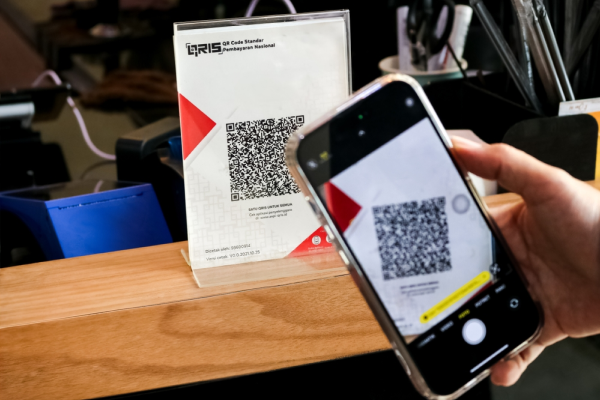
QRIS is a national QR code standard developed by Bank Indonesia to simplify digital payment transactions. With QRIS, customers only need to scan one QR code using various payment apps, such as e-wallets or mobile banking without switching between different systems.
The process is straightforward. Merchants provide a QRIS code (either static or dynamic), and customers scan it using their preferred payment application. If it’s a static QRIS, customers manually input the payment amount. If it’s dynamic, the amount is automatically generated. The transaction is then processed in real time, and the funds are transferred directly to the merchant’s account.
This efficiency is what makes QRIS widely adopted, but it also creates opportunities for fraudsters to exploit the system.
QRIS Payment vs QRIS Transfer: What’s the Difference?
Although both use QR codes, QRIS payment and QRIS transfer serve entirely different purposes. Understanding this distinction is crucial to avoid falling victim to fraud.
QRIS Payment
-
Specifically designed for transactions between customers and merchants
-
Funds are directly credited to a registered business account
-
Commonly used in stores, restaurants, SMEs, and professional services
-
Supports transaction records for better financial tracking
-
Available as static (manual input) or dynamic (auto-generated amount) QR codes
-
More secure due to integration with licensed payment service providers
QRIS Transfer
-
Used for peer-to-peer money transfers or sending funds to individuals
-
Not limited to commercial transactions
-
Funds go to the account linked to the scanned QR code
-
Typically not integrated with business transaction systems
-
More flexible but also riskier without proper verification
Failing to recognize this difference can make it easier for scammers to replace a legitimate merchant QRIS with a personal QR code, redirecting payments to their own account.
Types of QRIS Scam Merchants Must Watch For
The digital payment landscape is increasingly targeted by organized cybercriminals. Below are the most prevalent scam QRIS tactics currently disrupting the market:
1. Fake QRIS Sticker (QRIS Tampering)
This is one of the most common scams involving a fake QR code. Fraudsters replace or cover the original QRIS with their own QR code sticker, redirecting payments to their account.
An example of fake QR code tampering involves high-traffic venues like street food stalls or transit kiosks, where staff rarely monitor payment signage. Without routine visual audits, businesses may process dozens of orders daily while payments silently divert elsewhere.
2. QRIS Screenshot and Fake Proof of Payment Method
In this scheme, scammers present a screenshot of a payment confirmation that is either reused or digitally altered.
Merchants who rely solely on visual proof without verifying transactions in their system risk accepting fake payments. This tactic is especially common in fast-paced environments like retail stores or busy restaurants.
3. QRIS Account Switching Fraud
This type of fraud involves altering the destination account linked to a QRIS code. It can happen through system manipulation or social engineering tactics.
In some cases, scammers trick merchants into using a modified QRIS. As a result, all customer payments are redirected to the fraudster’s account instead of the business account.
4. Scamming
Scamming covers a wide range of deceptive practices that rely on psychological manipulation. Fraudsters may pose as customers, delivery personnel, or even representatives from payment providers.
They often exploit urgency or confusion to prevent merchants from verifying transactions properly. This method is particularly dangerous because it targets human behavior rather than system vulnerabilities.
5. Quishing Method (QR Phishing) via Social Media
Quishing, or QR phishing, is a growing threat where scammers distribute malicious QR codes through social media or messaging platforms.
These QR codes may lead to fake login pages designed to steal sensitive information such as usernames, passwords, or payment credentials. Once accessed, scammers can take control of accounts and carry out fraudulent transactions.
Preventive Measures for Businesses
To protect your business from QRIS scams, proactive steps are essential. Here are practical measures you can implement:
1. Use QRIS from Official Providers
Never print, download, or accept QRIS materials from unverified third parties. Always generate your QR codes through licensed, PJSP-certified payment partners. Official providers embed cryptographic security layers, transaction monitoring, and dispute resolution mechanisms that unauthorized generators simply cannot replicate.
2. Don’t Rely on Screenshots Alone
Adopt a strict "no screenshot acceptance" policy. Train your frontline staff to cross-reference every payment using your merchant dashboard, official banking app, or POS notification system. Real-time verification eliminates reliance on easily forged digital receipts and ensures funds are cleared before order fulfillment.
3. Protect Your Devices and Data
Protect your payment infrastructure with enterprise-grade cybersecurity protocols. Install reputable anti-malware software, enforce automatic system updates, and deploy strong, unique passwords for all merchant portals.
Never share login credentials, OTPs, or administrative access with unauthorized personnel. Enable biometric or hardware-based authentication wherever possible.
4. Use Dynamic QRIS and Real-Time Verification
Transition from static to dynamic QRIS codes wherever feasible. Dynamic codes generate a unique, single-use identifier for each transaction, with the exact amount locked before scanning. This architecture neutralizes amount manipulation and screenshot recycling. Pair this with instant notification systems that alert staff the moment funds are successfully deposited, eliminating guesswork and accelerating checkout throughput.
QRIS fraud is a real and evolving threat that can harm businesses if not properly addressed. Awareness and preventive action are your best defenses.
Fortunately, technology now offers robust countermeasures. The Soundbox from Telkomsel Enterprise delivers an intelligent, hands-free verification layer by broadcasting instant audio confirmations the moment a transaction successfully clears into your merchant account. By removing reliance on customer-provided screenshots or manual dashboard checks, Soundbox transforms payment verification into a seamless, foolproof process.
Don’t wait until your business becomes a victim of a scam QRIS. Deploy the Soundbox from Telkomsel Enterprise today and guarantee that every digital transaction remains secure, instantaneous, and fully transparent.